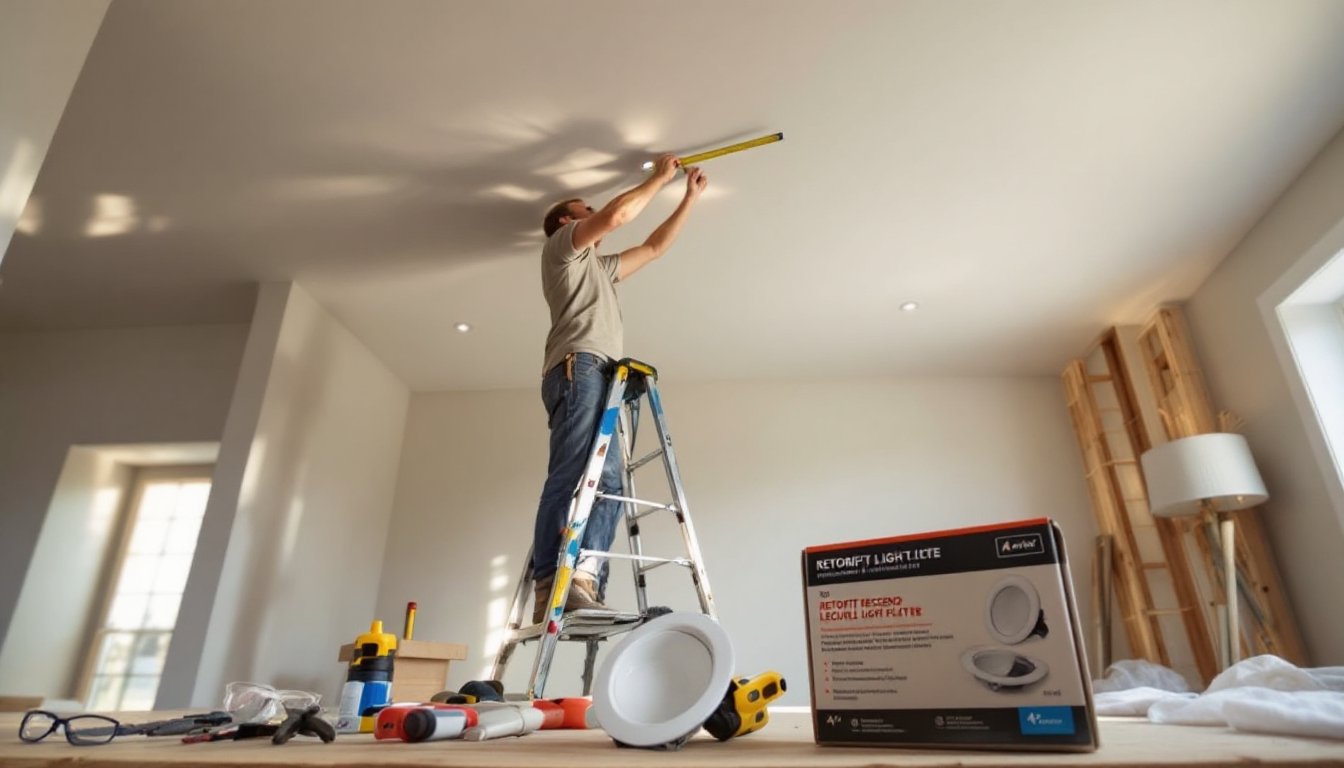
Not every homeowner has attic access, and that shouldn’t stop you from installing recessed lighting. Whether you’re working with a finished attic, a low crawl space, or a cathedral ceiling, retrofit recessed lighting offers a practical alternative to traditional above-joist installation. This guide walks you through the most realistic options for adding recessed lighting without climbing into an attic, what tools and materials you’ll need, and the common pitfalls to avoid. By the end, you’ll know exactly which approach fits your situation and how to execute it safely.
Table of Contents
ToggleKey Takeaways
- Retrofit recessed lighting allows you to install modern ceiling lights without attic access by working from below the ceiling with spring-loaded or screw-in flanges.
- Space recessed lights 4 to 6 feet apart in a grid pattern and always mark locations twice before cutting drywall holes to ensure even coverage and proper alignment.
- Use 14/2 NM cable for 15-amp circuits or 12/2 NM cable for 20-amp circuits, and always kill power at the breaker and confirm dead circuits with a voltage tester before handling any wiring.
- Retrofit cans are typically $25–$60 each and cost more than traditional fixtures but eliminate the need for structural work like cutting joists or accessing finished attics.
- Avoid common mistakes like cutting holes that are too small or too large, overtightening mounting screws that crush drywall, and ignoring circuit load calculations to prevent breaker trips.
- Know when to call a licensed electrician for electrical capacity verification, permit compliance, and structural concerns—hiring a professional is safer and cheaper than dealing with code violations or fire hazards.
Understanding Surface-Mount And Retrofit Recessed Lighting Options
Retrofit recessed lights and surface-mount fixtures are your primary workarounds when attic access isn’t available. Retrofit recessed lights (also called remodel cans) are installed from below the ceiling and don’t require access from above. They clamp onto drywall from the underside using spring-loaded or screw-in flanges that secure the fixture housing inside the cavity. These come in standard sizes: 4-inch and 6-inch diameters being most common for general lighting.
Surface-mount options include semi-flush ceiling fixtures, track lighting, and flush-mount panels that sit directly against the ceiling surface. While these don’t give you the sleek integrated look of true recessed lights, they provide solid ambient or task lighting without ceiling demolition.
Trim rings and lens covers for retrofit cans come in various styles, open, baffle, and pinhole trims affect both appearance and light distribution. Baffle trims reduce glare by hiding the bulb: open trims maximize brightness. Know what finish you want (brushed nickel, white, bronze) before you buy, because mixing finishes in one room reads as unintentional. Retrofit fixtures are more expensive per unit than traditional cans, typically running $25–$60 each depending on features like IC ratings (insulation contact, meaning they can sit against insulation) and dimmer compatibility.
Why Traditional Attic Access Isn’t Always Necessary
Traditional recessed lighting assumes you’re running wiring and securing fixtures from above the joist, which requires ripping open and patching the attic floor or crawl space, messy, time-consuming, and impossible in finished attics or single-story homes with no attic above. Retrofit recessed lights sidestep that entirely by letting you work from below, meaning you only make holes in your finished ceiling where you want the lights to actually sit.
This approach also scales down the electrical work. Rather than running new circuits through joists and up walls from the breaker panel, you can often tie retrofit lights into an existing ceiling fixture circuit or nearby outlet, depending on your home’s electrical layout and local code. That said, the National Electrical Code (NEC) has strict rules about junction boxes, wire sizing, and branch circuit capacity, before you start, understand the basics of recessed lighting so you know when to call a licensed electrician.
Retrofit fixtures also save you from the structural headache of cutting joists or dealing with blocked cavities from HVAC ducts or plumbing. If your ceiling is a finished concrete soffit, a cathedral slope, or a drop ceiling over a second floor, retrofit recessed lights might be your only DIY-friendly option.
Step-By-Step Installation Process For Retrofit Lights
Preparing Your Ceiling And Electrical Setup
Start by marking your light locations on the ceiling using a pencil and measuring tape. A good rule of thumb: space recessed lights 4 to 6 feet apart in a grid for even coverage. Measure twice, mark once, misaligned lights will bother you every time you look up. Use a stud finder to locate joists, and avoid placing fixtures directly over studs or ducts. Once marked, use a drywall saw (or a hole saw if your retrofit can comes with a template) to cut your opening. Retrofit cans typically require 4–6 inch diameter holes, so measure your specific model.
Before cutting, turn off power to the circuit you plan to tap into at the breaker panel. Use a non-contact voltage tester to confirm the power is truly off. Retrofit fixtures most commonly connect to existing ceiling light circuits or nearby outlets. You’ll need to run cable from the power source to each fixture. Use 14/2 NM cable for 15-amp circuits or 12/2 NM cable for 20-amp circuits: your local code may require specific installation methods (conduit, stapling intervals, etc.). Install a junction box wherever you transition from one cable run to another, and use wire nuts rated for your wire gauge and number of connections.
Mounting And Securing Your Recessed Fixtures
Once your holes are cut and wiring is in place, insert the retrofit can into the opening from below. Most retrofit cans use spring-loaded tabs or screw-in flanges to grip the drywall. Push the housing up into the cavity, then tighten the screws or release the tabs to clamp the fixture to the drywall thickness. Don’t overtighten, you want firm grip, not crushed drywall. The fixture should sit flush with the ceiling surface.
Connect the wiring inside the can using wire nuts. Most retrofit cans come with a pre-installed junction box inside the housing, which simplifies things. Strip about ½ inch of insulation from each wire, twist the bare copper and ground wires together with their mates from the fixture, and cap with appropriately rated wire nuts. Tuck the excess wiring back into the can cavity.
Install the trim ring and bulb according to the fixture’s instructions. LED A19 or BR30 bulbs are standard for retrofit cans: confirm your fixture’s maximum wattage rating (often 75W equivalent or less for LED). Incandescent bulbs run hotter, so they’re less popular now, but if you use them, never exceed the marked limit, fire hazard. Test each light at the wall switch before patching drywall.
For larger projects with multiple lights on one circuit, a licensed electrician is worth the cost to verify your load calculations and ensure compliance with local code.
Tools, Materials, And Safety Considerations You’ll Need
Tools:
- Measuring tape, pencil, level
- Stud finder and non-contact voltage tester
- Drywall saw or hole saw (sized to your fixture)
- Wire strippers, needle-nose pliers, screwdrivers
- Flashlight or headlamp
Materials:
- Retrofit recessed light fixtures (4–6 inch, appropriate for your ceiling thickness and IR rating)
- NM cable (14/2 or 12/2, per your circuit amperage)
- Wire nuts (rated for 12 AWG or 14 AWG, depending on your wire)
- Trim rings, bulbs, and gaskets (if not pre-included)
- Drywall patch material and joint compound for any damaged edges
Safety First:
Wear safety glasses when cutting drywall, dust and debris fly. If cutting fiberglass insulation or working in older homes with potential asbestos (pre-1970s insulation), wear a fitted N95 or P100 mask and dampen the area before cutting. Use gloves when handling wiring to prevent minor cuts. Most importantly, kill power at the breaker before touching any wires, and confirm dead circuits with a voltage tester every single time. Electrical shock or fire risk is real. If you’re uncomfortable with the wiring portion, hire a licensed electrician for that step, it’s not worth a mishap.
Common Mistakes To Avoid And Troubleshooting Tips
Underestimating hole size: Retrofit cans have a standard hole diameter (usually printed on the packaging or fixture body). Cutting too small means the fixture won’t fit: too large and drywall support fails. Use the template provided or measure three times.
Overtightening mounting screws: Spring-loaded tabs and screw flanges are designed to grip, not crush. Tighten until snug, then stop. Crushed drywall won’t hold, and you’ll have a fixture that sags or falls.
Ignoring wire sizing and circuit load: If you’re adding six 12W LED bulbs to a circuit already handling a ceiling fan and a wall outlet, you might trip the breaker or cause nuisance breaker trips. Calculate total load. A typical 15-amp, 120V circuit can safely handle about 1,440 watts continuous: account for other loads on the circuit.
Mixing retrofit cans with old ceiling joists: If your ceiling joists are damaged, warped, or nonstandard spacing, retrofit lights can still work, but you need solid drywall backing. Avoid areas where water damage or pest damage has compromised the ceiling structure.
Not sealing air gaps: Retrofit cans can be an air leak path between conditioned and unconditioned spaces. Use caulk or gaskets (often included) to seal gaps between the trim ring and drywall. This matters for both comfort and utility bills.
Troubleshooting: If a light doesn’t turn on, confirm the breaker is on and the wire connections are secure inside the can. Use a voltage tester to verify power reaches the fixture. Flickering often means a loose connection or mismatched dimmer, non-dimmable LED bulbs don’t play nice with older dimmer switches. Switching to dimmable LED bulbs or replacing the dimmer solves it. If multiple lights go out together, suspect a tripped breaker or a failed junction box connection rather than individual fixture failure.
Final Thoughts: Know Your Limits And When To Call A Pro
Retrofit recessed lighting is a realistic DIY project if you’re comfortable with basic wiring and hole-cutting. The learning curve is shallow, most homeowners succeed on their first try. That said, there’s a hard line: if you’re unsure about your home’s electrical capacity, local permit requirements (many jurisdictions require permits for new circuits or modifications), or structural concerns, hire a licensed electrician or contractor. A few hundred dollars beats a code violation, a fire, or worse. Plan your layout carefully, use the right tools, follow safety rules, and you’ll have professional-looking recessed lighting without ever setting foot in an attic.