A well-lit front yard does more than brighten the darkness, it adds security, defines your home’s architectural character, and creates a welcoming first impression. Whether you’re walking up to your house at dusk or entertaining guests on the porch, outdoor front yard lighting sets the mood and guides movement. This guide walks through practical outdoor lighting ideas that blend function with aesthetics, from simple path lights to dramatic uplighting on focal points. No matter your budget or technical comfort level, there’s a lighting solution that fits your home and style.
Table of Contents
ToggleKey Takeaways
- Path and walkway lighting spaced 4 to 6 feet apart at 12 to 18 inches high safely guides foot traffic while creating visual appeal from street to entry.
- Front yard outdoor lighting should layer ambient, task, and accent lighting with warm color temperatures (2700K to 3000K) to create depth and an inviting atmosphere.
- Uplighting trees and focal points with appropriately sized LED fixtures (20 to 50 watts depending on size) creates dramatic visual interest and enhances your home’s architecture.
- Entry and porch lighting requires at least 300 lumens for security and should use symmetrical wall-mounted sconces at eye level (60 to 66 inches) to frame the front door.
- Low-voltage systems and solar-powered lights offer DIY-friendly installation without permits or complex wiring, while modern LEDs deliver 25,000 to 50,000 hours of reliable operation.
- Smart outdoor lighting with WiFi controls and dimmers allows you to adjust brightness and scheduling from your phone, adapting your front yard lighting to different moods and occasions.
Path and Walkway Lighting Essentials
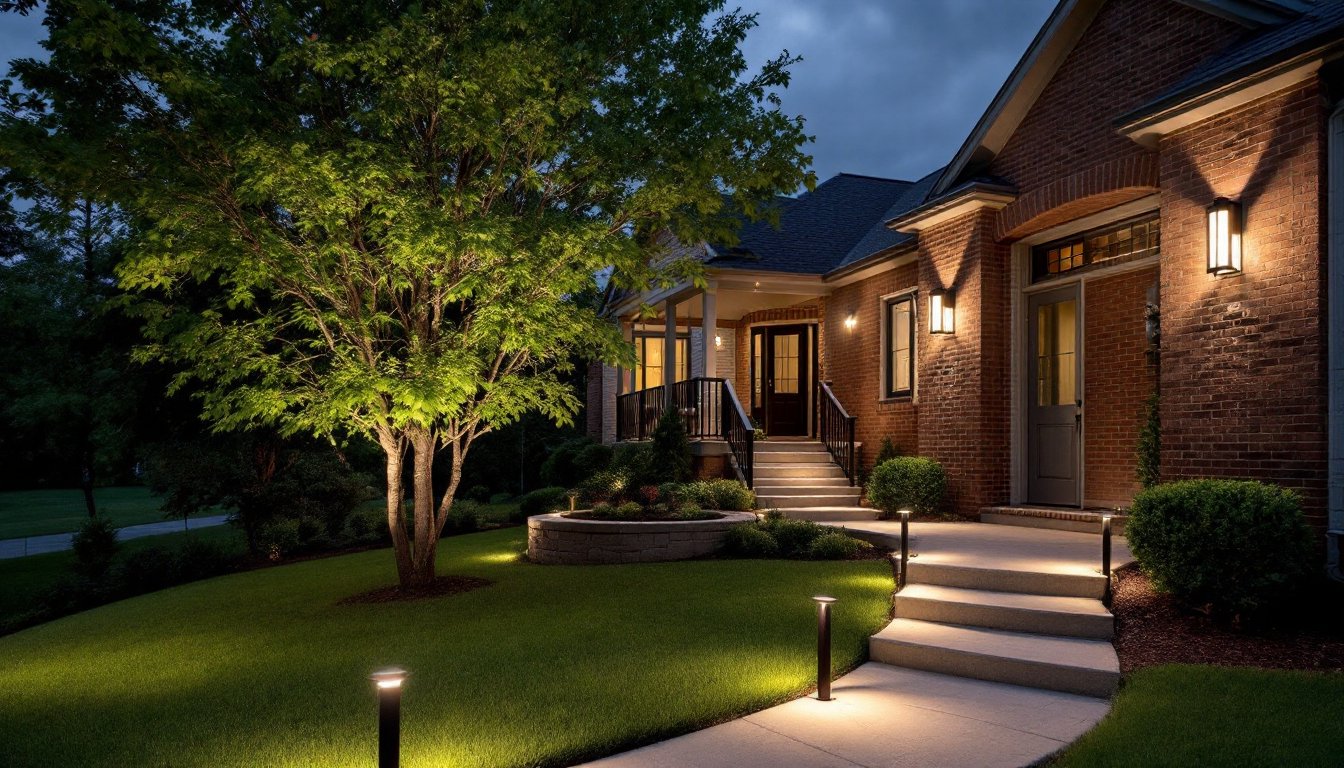
Path lighting is the workhorse of front yard design. It guides foot traffic safely while creating a visual framework that draws the eye from street to entry. The key is spacing: lights placed 12 to 18 inches high at 4- to 6-foot intervals create even illumination without blinding glare or dark gaps.
Choose between two main styles. Stake lights (the most common) push into soil or mulch and work well along planting beds and irregular pathways. Bollard lights, which stand 18 to 24 inches tall, suit more formal walkways and provide stronger, wider light pools. Both styles come in brass, copper, stainless steel, and plastic finishes, pick what complements your home’s materials.
One often-overlooked detail: avoid lights that shine upward into eyes. Look for fixtures with downward-directed LEDs or frosted diffusers. Brightness matters too. Most path lights deliver 50 to 150 lumens, which is plenty for safe navigation without harsh shadows. Test placement before committing: move a few lights around at dusk to see how they affect sight lines.
Path lighting is one of the easiest DIY additions. Solar options require zero wiring, while low-voltage systems (discussed below) need a simple buried cable and transformer. Either way, plan the route before you buy, measure your walkway length and count the number of fixtures you’ll need.
Accent Lighting for Landscape Features
Accent lights highlight specific landscape elements, a stone planter, a textured wall section, a shrub border, or architectural detail. These lights are smaller and often colored (warm white, amber, or even subtle RGB), and they work best in small clusters rather than spread across the yard.
For planting beds and low shrubs, use spot or well lights that sit flush with or just above ground and direct light upward. For vertical surfaces like a brick facade or fence, position lights at ground level shining upward at a 45-degree angle. This creates dimension and avoids a flat, washed-out look.
One common mistake is overlighting. Three or four accent lights on different features look intentional: a dozen scattered randomly looks chaotic. Dimmer controls help you dial in the right intensity for different occasions. Warm white tones (2700K to 3000K color temperature) feel inviting and traditional, while cooler whites (4000K to 5000K) read more modern and energetic.
Accent lighting pairs beautifully with seasonal decorating. During fall and winter, Fall Outdoor Decorating can include strategic uplighting on existing plants and hardscape. The layering of ambient, accent, and seasonal touches creates depth and visual interest that pure white path lighting cannot match.
Uplighting Trees and Focal Points
Uplighting a large tree is one of the most dramatic transformations you can make to a front yard. Position a ground-mounted uplight or well light directly beneath or slightly away from the trunk, aiming upward to silhouette branches against the sky. This technique works best on trees with interesting branch structure, mature oaks, crabapples, ornamental cherries, and large evergreens all respond well.
Choose fixture wattage based on tree size. Small trees under 20 feet tall need 20 to 35 watts from an LED uplight, while larger specimens may require 50 watts or more. Position the light 2 to 4 feet from the trunk to avoid harsh shadows directly on the tree. Adjust the angle gradually at dusk, too steep and branches blend into sky: too shallow and you lose definition.
For comprehensive guidance on uplighting techniques, research demonstrates that landscape uplighting creates depth and visual hierarchy without overwhelming the space. The goal is enhancement, not floodlighting.
If your focal point is architectural, a stone column, a water feature, or a wall, use narrow-beam spotlights or accent lights positioned to emphasize texture and form. Test placement before installation: borrow a work light on an extension cord to preview the effect. Once you find the sweet spot, mark the fixture location with spray paint so installation goes smoothly.
Entry and Porch Lighting Solutions
Your front entry light sets the tone and serves a practical purpose: illuminating the keyhole and front door handle. Most homes need two to four fixtures on the porch or flanking the entryway to avoid dark corners and create balanced lighting.
Wall-mounted sconces on either side of the door are the traditional choice. Position them eye level (60 to 66 inches from the floor) and ensure they’re spaced evenly from the door. This symmetry feels intentional and welcoming. Alternatively, a single ceiling-mounted fixture, a lantern or flush mount, works for smaller porches. Pair it with low-level path lights or step lights to guide the approach.
Brightness and style matter equally. For security, aim for at least 300 lumens at the entry point. For ambiance, choose warm-white LED bulbs (2700K) in fixtures made from materials that match your exterior, brass for traditional homes, matte black for modern, or natural wood for rustic builds. Smart bulbs or dimmers let you adjust intensity for different times of day.
Don’t forget step and stair lighting if your porch is elevated. Recessed step lights (installed into the vertical face of risers) or under-rail lights (mounted on handrail edges) prevent trips and stumbles. These are essential for safety and often required by building code on stairs serving three or more risers. For the holidays, Rustic Front Porch Christmas decorating can layer entry lighting with warm garland and additional seasonal fixtures to create a cohesive, inviting threshold.
Low-Voltage and Solar-Powered Options
Low-voltage (typically 12-volt) and solar systems are the easiest DIY installations because they require no trenching, electrical permits, or licensed electrician sign-off. Both deliver excellent results when chosen and installed correctly.
Low-voltage systems use a transformer (plugged into a standard outdoor outlet) that steps down household current to safer, lower voltage. Run insulated cable along fence lines, under mulch, or through conduit to all fixtures. The transformer often includes a timer and photocell, so lights turn on automatically at dusk. Advantages: consistent, reliable brightness: dimmable controls: and the ability to power multiple fixtures from one transformer. Downside: you need a nearby outlet and some basic wire-running skills.
Solar lights charge during the day via built-in panels and glow all night (typically 6 to 10 hours on a full charge). Zero wiring, no permits, no monthly electricity cost. Modern LEDs in solar fixtures are far brighter than older models, look for at least 100 lumens in path lights and 150+ lumens in accent or uplighting fixtures. Downsides: clouds and shading reduce effectiveness: batteries degrade over a few seasons: some cheaper units look plasticky and dim quickly into evening.
For homeowners wanting flexibility, mix both approaches. Use low-voltage for primary entry and security lighting, then add solar path lights and accents to expand coverage without additional wiring. LED technologies in both systems are highly efficient and long-lasting, so expect 25,000 to 50,000 hours of operation before replacement, far outlasting traditional incandescent or halogen bulbs.
Modern Design Trends for Front Yard Lighting
Current trends lean toward layered, cohesive lighting schemes rather than spotty, one-off fixtures. Warm color temperatures (2700K) dominate residential spaces, creating a cozy atmosphere that feels more human and inviting than cool whites. Modern fixtures also favor clean lines and minimal profiles, narrow bollards, flush architectural sconces, and recessed ground lights that disappear during the day.
Smart outdoor lighting is gaining traction. WiFi-enabled fixtures let you control brightness, color, and scheduling from your phone, turning lights on before you arrive home or dimming them for relaxed evening entertaining. Some integrate with voice assistants, allowing hands-free commands. Price is higher upfront, but if tech appeals to you and you plan to stay in your home, the convenience justifies the investment.
Another trend is layered lighting by function. Separate controls for ambient (overall illumination), task (entry and step lighting), and accent (trees, features) lighting let you adapt the yard to different moods. You might set accent lights bright for security but dial them back for a quiet evening. This flexibility makes a modest lighting budget feel much more capable.
For design inspiration across all your outdoor spaces, LED Strip Lighting Ideas offers creative solutions for under-deck, under-rail, and architectural applications that extend lighting concepts beyond traditional front yard fixtures. Also, designers at Southern Living showcase regional approaches to porch and entry lighting that blend tradition with contemporary aesthetics. Regional climate and architectural style matter, a Mediterranean villa’s outdoor lighting differs sharply from a New England colonial or a modern farmhouse.
Conclusion
Front yard outdoor lighting transforms your home’s curb appeal while serving essential safety and security functions. Start with path and entry lighting, then layer in accent and uplighting to create depth and visual interest. Whether you choose low-voltage systems for dependable brightness or solar options for install-and-forget simplicity, modern LED technology keeps costs and energy use low while delivering years of reliable service. Plan before you buy, test placement at dusk, and don’t over-light, restraint and balance always look better than excessive brightness.