Kitchen lighting does more than illuminate your countertops, it shapes how you cook, dine, and live in the heart of your home. Poor lighting turns food prep into a safety hazard and steals the charm from evening gatherings. The right kitchen lighting ideas combine function with style, layering different types of fixtures to handle everything from precision chopping to ambient dinner conversations. Whether you’re remodeling or upgrading fixtures, understanding how to balance task, ambient, and accent lighting transforms your kitchen from dim and uninviting to bright, welcoming, and genuinely functional.
Table of Contents
ToggleKey Takeaways
- Layered kitchen lighting ideas combining task, ambient, and accent sources creates a flexible space that adapts from bright meal prep to warm entertaining.
- Task lighting over work zones—especially under-cabinet fixtures delivering 300–500 lumens per linear foot—eliminates shadows and improves safety during food preparation.
- Ambient lighting should be spaced 4–6 feet apart at 8–10 feet high, with dimmers on at least 50% of fixtures to transition between bright cooking and softer dining moods.
- Accent lighting highlights glass cabinets, shelving, and design features with LED strips or pendant lights, adding personality and depth without cluttering the workspace.
- Budget-friendly upgrades like LED strip kits ($20–$50) and retrofit trim kits avoid expensive rewiring, making incremental kitchen lighting improvements accessible to most homeowners.
- Proper fixture placement—pendants 24–30 inches above island seating, sink lights 18–24 inches forward of backsplash, stovetop fixtures at least 200 lumens—ensures both safety and visual comfort.
Layer Your Lighting for Function and Ambiance
The golden rule of kitchen lighting is simple: never rely on a single fixture. A single overhead light casts shadows over your workspace, makes cooking frustrating, and looks flat when you’re entertaining. Layered lighting, combining task, ambient, and accent sources, solves this in one stroke.
Think of it like seasoning: you need base notes (ambient), punch notes (task), and highlights (accent). Ambient lighting provides overall illumination, task lighting targets work zones, and accent lighting draws attention to architectural features or collections. Together, they create a flexible space that adapts to your needs. A kitchen that feels bright and energetic during meal prep becomes warm and inviting by dimming ambient fixtures and keeping accent lights on low.
When planning your layout, map out where you actually work. Most kitchens have three zones: the sink, the stove, and the prep counter. Each needs dedicated task lighting. Your general circulation, walking from the fridge to the pantry, needs ambient coverage. Any open shelving, glass cabinets, or design features worth highlighting? That’s where accent lighting shines.
Task Lighting: Brighten Work Zones
Task lighting is your workhorse. It’s the difference between a sharp, safe knife cut and a guessing game that ends badly. For under-cabinet fixtures, under cabinet kitchen lighting eliminates the shadows your body casts over the counter, a problem standard overhead fixtures can’t solve.
Underlighting should deliver 300–500 lumens per linear foot of counter space. LED strips are ideal here: they’re thin, efficient, and produce minimal heat that could damage cabinetry. Consider warm white (2700K) for a softer appearance, or cool white (4000K) if you want surgical precision while prepping. For island work surfaces, pendant lights or small downlights mounted 30–36 inches above the counter provide focused illumination without glare.
When installing task lighting over the sink, position fixtures 18–24 inches forward of the backsplash to avoid casting shadows into the basin. A recessed downlight or semi-flush mount works here: make sure it’s rated for potential splashing. Installing under cabinet lighting typically requires routing for wiring along the inside bottom of cabinets, straightforward with careful measurement, but tedious without a helper.
For stovetop safety, a hood-mounted light with at least 200 lumens handles both cooking visibility and ventilation. Never position task lights directly above a stove burner: the heat can damage some fixture materials and create glare that impairs your vision.
Ambient Lighting: Set the Mood
Ambient lighting is your kitchen’s backbone, the overall glow that lets you move safely and see without eyestrain. Unlike task lights that target specific zones, ambient fixtures distribute light across the entire room, typically at a lower intensity.
Recessed downlights, the workhorses of modern kitchens, should be spaced 4–6 feet apart and mounted 8–10 feet high for even coverage. They disappear visually, letting cabinetry and finishes take the spotlight. Alternatively, semi-flush or flush-mount fixtures over islands or the main work area provide warmth and architectural interest that recessed lights can’t match. A 3000K color temperature feels welcoming without being yellow: 4000K adds energy without feeling clinical.
Large kitchens benefit from two or three ambient sources: maybe recessed lights in the work zone, a flush-mount near the pantry, and another over the dining area. This prevents dark corners and lets you adjust brightness zones independently. If your kitchen opens to a dining or living area, modern farmhouse dining room lighting can provide ideas for cohesive ambient control that unifies the spaces.
Dimmers are non-negotiable. A kitchen needs bright light when cooking a Thanksgiving dinner and softer light when hosting a quiet evening. Install dimmers on at least 50% of your ambient fixtures. Make sure fixtures are compatible with LED dimming, not all LEDs play nicely with every dimmer, and incompatibility causes flickering or reduces brightness range.
Accent Lighting: Highlight Your Design
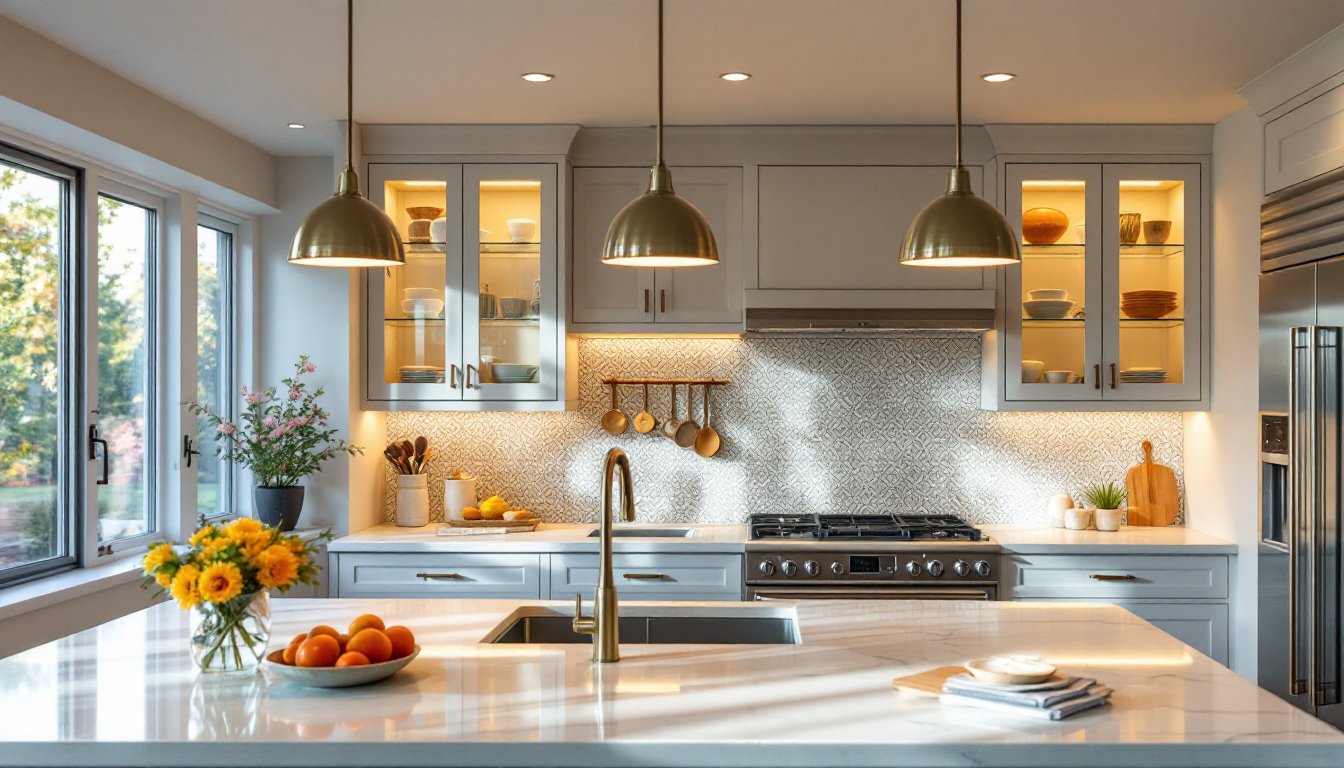
Accent lighting is where your kitchen’s personality emerges. It highlights glass-door cabinets, floating shelves, crown molding, or a prized tile backsplash, anything worth showcasing. LED strip lighting inside glass cabinetry creates a gallery effect that makes dishware or glassware collections into part of your decor. Mount strips along the underside of shelves or the top edge of cabinets for even illumination without visible hardware.
Wall sconces flanking a decorative mirror or art near the dining transition add character and indirect light. Pendant lights over islands or peninsulas function as both task and accent pieces, they’re sculptural enough to draw the eye while providing functional downlighting. Trend-setting oversized sculptural pendant lights showcase how statement-making fixtures can anchor kitchen design.
Inside cabinet lighting transforms open shelving into display space rather than a storage slot. The glow softens a kitchen’s appearance and adds depth to wall elevations. Keep accent lighting separate from dimmers controlling task and ambient sources. You want the flexibility to enjoy accent fixtures at full glow during entertaining while dimming work lights for mood.
Color temperature matters less for accent lighting, but consistency with ambient fixtures prevents a disjointed look. Avoid mixing warm and cool tones in the same visual space, it creates tension rather than polish.
Fixture Styles That Match Your Kitchen
Your kitchen’s style dictates which fixtures work. Modern kitchens favor minimal recessed lights, sleek pendant lights with metal shades, and clean-lined strips. Farmhouse kitchens shine with exposed wood or wrought-iron pendants, candle-style sconces, and warm Edison bulbs that hint at vintage charm. Transitional spaces, the most forgiving, blend styles comfortably: maybe shaker-style cabinets with mid-century modern pendants.
Pendants are the visible star of most kitchens. Hang them 12–15 inches above island countertops if seating is absent, or 24–30 inches above if diners sit beneath (to avoid glare in eyes). Three pendants roughly 2–3 feet apart work for islands 10–14 feet long. A single statement pendant suits smaller islands or peninsula ends.
Understanding fixture ratings matters. Look for damp-rated fixtures near sinks (rated for moisture but not direct spray). Fixtures near cooktops should tolerate heat: IC-rated recessed fixtures handle insulation contact. Chandeliers and ornamental pieces are fine in dining transitions but impractical over active work surfaces, they collect dust and grease.
If you’re drawn to home design research and inspiration, browsing built projects in your style helps narrow fixture choices before shopping. Most showrooms let you see finishes under multiple lighting conditions, which reveals how fixtures feel in warm versus cool light.
Budget-Friendly Upgrades and Smart Solutions
Not every kitchen lighting upgrade requires a full rewire. If your electrical layout is solid, you can refresh lighting in phases.
LED strip lights are the cheapest entry: a 16-foot strip kit runs $20–$50, plugs into a standard outlet, and installs with adhesive tape. No electrician needed. Retrofit recessed trim kits let you replace incandescent cans with modern LED housings without opening ceilings, a two-hour job. A basic LED trim kit costs $30–$60 per can.
Swapping out a semi-flush fixture for a fixture with the same mounting plate is a safe DIY task if you’re comfortable working with a breaker panel (flip off power, test with a voltage tester, disconnect old wiring, connect new). Pendant lights over an island can hang from existing ductwork or a new J-box if one doesn’t exist, that’s a licensed electrician call in most jurisdictions.
Smart bulbs and dimmer switches add flexibility for under $30. A WiFi-enabled bulb lets you adjust brightness and color temperature from your phone, useful if you’re washing dishes and realize you need more light on the counter without touching a switch. Smart dimmers replace standard switches and pair with voice assistants.
If rewiring is off the table, focus on what’s practical: task lighting via strips or under-cabinet fixtures, better ambient control through dimmers on existing fixtures, and accent lighting in open spaces. Laundry room lighting ideas demonstrate how even modest spaces benefit from layered thinking, the same principles apply when budgets are tight.
Always check local building codes before any hard-wired work. Some jurisdictions require permits for electrical additions: others allow homeowner rewiring only to a certain capacity. It’s not worth a safety violation or an insurance claim.
Conclusion
A well-lit kitchen is a safer, more enjoyable kitchen. Layering task, ambient, and accent lighting lets you adapt the space to cooking, dining, or entertaining without feeling flat or harsh. Start with your work zones, get the countertops and sink properly lit, then build ambient brightness and accent features around them. Even small upgrades like LED strip lighting under cabinets or a dimmer switch unlock the full potential of your lighting plan. The best kitchen lighting ideas are the ones you’ll actually use.