Small kitchens often feel cramped not because of square footage, but because of poor lighting. A kitchen that’s too dim makes cooking frustrating, chopping vegetables hazardous, and the space itself feel smaller than it actually is. The good news: smart lighting design can completely transform a compact kitchen without major renovation. Whether you’re renting and working with what you’ve got, or renovating your own space, the right combination of fixtures, layered thoughtfully across ambient, task, and accent lighting, will brighten your workspace, make it safer to work in, and even make the room feel larger. This guide covers exactly how to layer lighting in a small kitchen, which fixtures work best in tight quarters, and where to position them for maximum impact.
Table of Contents
ToggleKey Takeaways
- Small kitchen lighting transforms compact spaces from cramped to inviting by layering ambient, task, and accent lighting rather than relying on a single overhead fixture.
- Under-cabinet LED strips and task lighting over work surfaces are essential to eliminate shadows and improve safety when prepping food, cooking, and cleaning.
- Use warm color temperatures (2700K–3000K) and compact fixtures that don’t consume visual space, ensuring proper spacing of recessed lights 4–6 feet apart.
- A small kitchen of 100 square feet needs at least 5,000 lumens total distributed strategically, with task lights providing 75–100 foot-candles on prep areas.
- Smart placement of pendant lights (30–36 inches above counters), wall sconces (48–60 inches high), and strategic fixture selection can make a small kitchen feel larger and more functional.
- Light paint colors and mirrors amplify the effect of small kitchen lighting by reflecting light, while dimmers allow you to adjust mood and brightness for different tasks.
Why Lighting Matters in Small Kitchens
Lighting in a small kitchen isn’t just aesthetic, it directly affects safety, functionality, and how spacious your kitchen feels. Poor lighting leads to accidents: knife slips, misjudged stove temperatures, and missed spills. It also makes the space feel cramped and dungeon-like, even if the layout is efficient.
Small kitchens also reveal lighting mistakes more obviously than large ones. A single poorly placed fixture creates harsh shadows or glare that’s immediately noticeable. Conversely, well-planned layered lighting makes a compact kitchen feel open, inviting, and genuinely pleasant to work in.
The key is avoiding the single-overhead-light trap. One ceiling fixture, no matter how bright, leaves blind spots and creates shadows exactly where you need light most, over the sink, stove, and prep surfaces. Layering different types of lighting fixes this and gives you flexibility to adjust brightness and mood depending on the task.
Building codes don’t mandate specific kitchen lighting (codes vary by jurisdiction), but the National Kitchen and Bath Association recommends a minimum of 50 lumens per square foot for general kitchen lighting, with additional task lighting over work surfaces. A small kitchen, say, 100 square feet, needs at least 5,000 lumens total, split across multiple sources to avoid overwhelming the space.
Types of Lighting to Layer in Your Small Kitchen
Ambient Lighting as Your Foundation
Ambient lighting is your baseline, the general illumination that fills the room. In a small kitchen, you want this gentle enough not to feel harsh, but bright enough to navigate safely. Recessed lights or a flush-mount ceiling fixture work well here. Recessed fixtures are ideal for tight spaces because they mount flush to the ceiling and don’t eat up visual volume.
For a small kitchen, use warm color temperature (2700K–3000K) to keep the space feeling warm and inviting rather than sterile. If you choose recessed lights, space them roughly 4 to 6 feet apart: too many in a tiny kitchen creates a landing-strip effect. A single flush-mount fixture can anchor one end of the room, but pair it with task lighting elsewhere to avoid shadows.
Task Lighting for Work Surfaces
This is where you’ll spend your effort. Task lighting targets the areas where you actually work: the prep surface, stovetop, and sink. Without dedicated task lighting, these zones stay shadowed even if your ambient light is bright.
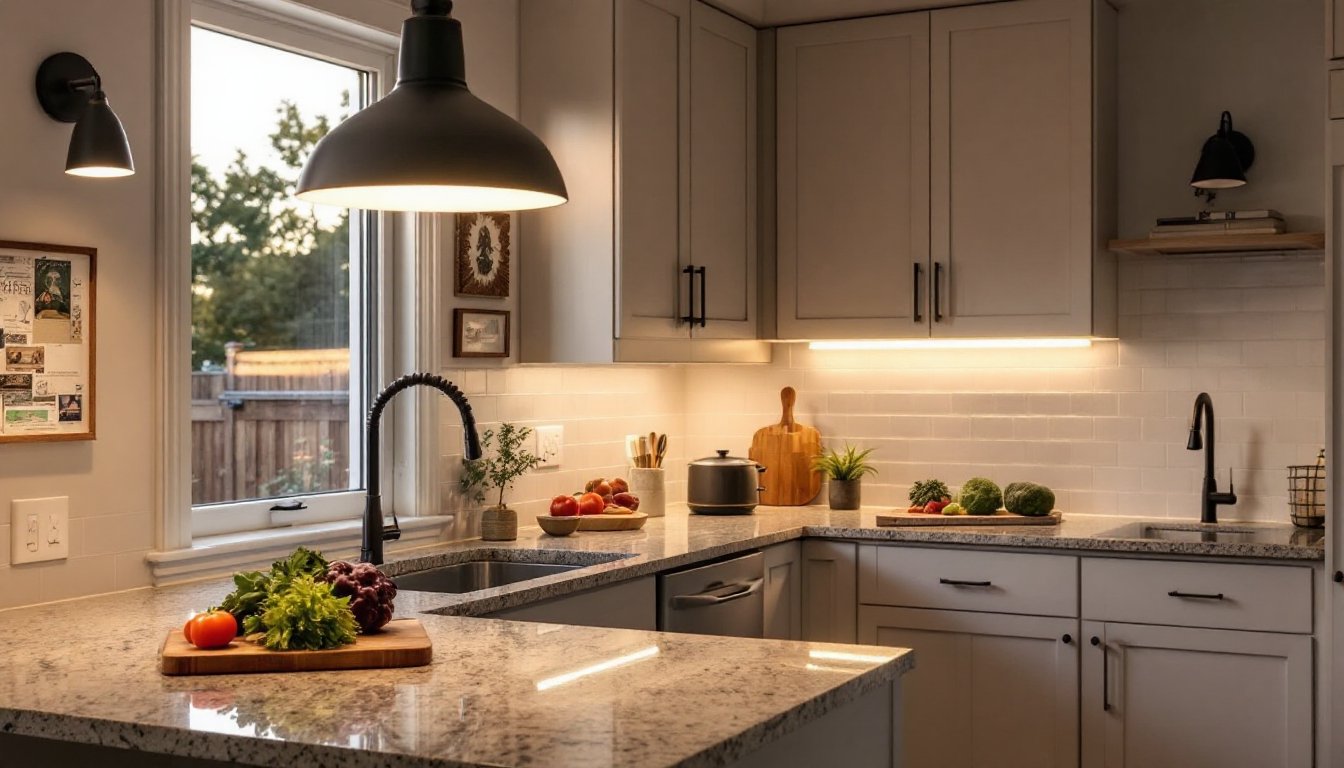
Under Cabinet Kitchen Lighting: is the workhorse solution for prep surfaces. LED strips or linear fixtures mounted on the underside of upper cabinets cast light directly onto your counter without glare or shadow. These are often installed 15–18 inches forward of the cabinet’s front edge for optimal spread.
Over the sink, a small pendant or directional sconce keeps you from standing in your own shadow while washing or prepping. Keep the fixture compact, a 10–12 inch shade is typically appropriate for a small kitchen. Over the stove, ensure your range hood has built-in lighting, or install a slim directional fixture (avoiding heat and moisture from the hood vent).
Task lights should be bright enough to see detail but not so bright they cause eye strain. Aim for 75–100 foot-candles on work surfaces (about 800–1000 lumens for a 10-square-foot prep area).
Accent Lighting for Visual Interest
Accent lighting highlights kitchen features and adds personality without overwhelming a small space. Inside Cabinet Lighting: Transform Your Kitchen with Style and Functionality draws the eye to open shelving or glass-front cabinets, making them a visual feature rather than just storage. This also lets you organize items aesthetically, glassware, cookbooks, or decorative pieces become part of the room’s design.
LED Strip Lighting Ideas work wonderfully in small kitchens because they’re thin, unobtrusive, and can be tucked into trim details, shelving edges, or alcoves. Warm 2700K LED strips create a welcoming glow without hogging visual space. Avoid over-lighting with accent fixtures: one or two accent zones per small kitchen is plenty.
Smart Fixture Choices for Compact Spaces
In a small kitchen, every fixture needs to earn its place. Oversized chandeliers and wide-shade pendants visually shrink the room further. Instead, prioritize compact, multifunctional fixtures.
Flush-mount or semi-flush fixtures save ceiling clearance. If your kitchen ceiling is less than 8 feet (common in older homes), a ceiling-hugging fixture keeps the room feeling open. Recessed lights are even less intrusive, though they require at least 6 inches of clearance in the joist cavity above the ceiling.
Narrow pendant lights work well over islands or peninsulas if space allows. A 7–10 inch diameter shade looks intentional in a small kitchen, whereas a 20-inch industrial pendant dwarfs the space. Adjustable height is useful: mount pendants 30–36 inches above the counter surface so they shed light without blocking sightlines.
Directional track lighting or adjustable sconces let you angle light exactly where it’s needed, minimizing wasted spill. A single track with 2–3 heads can cover multiple work zones from one mounted rail.
Moisture and ventilation matter. Kitchens near sinks or stoves are humid and steamy. Choose fixtures rated for damp or wet locations (look for “damp location” or “wet location” labels). Standard fixtures can corrode or fail in humid kitchens. Also ensure any fixture over the stove is at least 24–30 inches above the cooking surface (check your range hood manual for clearance requirements).
Dimming capability is worth the small cost. A dimmer switch on ambient or accent lights lets you adjust mood and brightness based on whether you’re meal-prepping or having dinner. Use dimmable bulbs (not all LEDs dim smoothly) with a compatible dimmer switch to avoid flickering.
Recessed or pendant light fixtures run $15–$80 per unit, depending on quality. Under-cabinet LED strips range from $30–$100 per 10-foot run. Budget for installation if you’re not comfortable running electrical work: an electrician will typically charge $100–$300 per fixture depending on location and wiring complexity.
Placement Strategies to Maximize Light
Positioning matters as much as fixture choice. A wrongly placed light leaves shadows: a well-placed one transforms the space.
Center recessed or flush fixtures in the main seating or cooking area, but offset them slightly toward work zones if space allows. In a very small kitchen, a single central fixture should be supplemented by task and accent lighting: never rely on it alone.
Install under-cabinet lighting on the front edge of upper cabinets (if present), running the strip along the full length of your prep surface. This eliminates the shadow cast by your own body and the cabinet overhang. If wiring is hidden in the cabinet frame or routed through the back, conceal it neatly: poor wiring looks amateur.
Pendant lights over an island or bar should hang centered above the counter, spaced 12–18 inches apart if multiple pendants are used. Avoid placing them so close together they create an unbroken strip of light, and avoid spacing them so far apart that shadows show between them.
Wall sconces flanking a sink window (if present) create balanced, shadow-free lighting. Mount them 12–16 inches on either side of the window frame and 48–60 inches above the floor (a comfortable height for most people).
Similar to Small Living Room Lighting, small kitchens benefit from mirrors or light paint colors that bounce light around. Even pale whites and light grays reflect light and make the space feel airier. This is a cheap win: light paint + strategic fixtures beats heavy fixtures alone.
Avoid these placement mistakes:
- Lights installed too high above work surfaces (creates glare and shadows)
- Pendant lights placed directly over where you’ll stand (guarantees head-bumping)
- Task lighting aimed at reflective backsplashes (causes glare)
- Accent lights that spill into adjacent rooms, diluting both spaces
When planning placement, sketch out your counter layout and mark where you prep, cook, and wash. Light those zones first. Accent and ambient light fill the remaining space. Most homeowners find that after installing proper task lighting, they need less overall ambient light than they expected.